The heating season rarely starts on an announced date. On a Tuesday evening in September the heating comes on for the first time, and only then does it become clear whether everything still works as it did last year. A radiator that stays cold, a thermostat that no longer switches, a ventilation unit making noise: each of these is a problem that can be prevented in advance. A check before autumn takes little time and avoids breakdowns at exactly the moment when installers have their longest waiting lists.
Why the check should happen before autumn
Between October and January, installers, plumbers and maintenance companies are at their busiest. A fault that can be resolved within a week in September often means a longer wait in December, an emergency rate, or a part that is not immediately in stock.
There is also a technical reason. Many defects are easier to identify when the system is under low load. An expansion vessel that slowly loses pressure, or a radiator that does not circulate properly, can be tested calmly while the system is not yet running intensively every day.
The season matters practically as well. Work on the façade, roof or window frames depends on dry weather. Anyone who identifies a problem in September still has a realistic chance of having it resolved this year.
Checking radiators and underfloor heating
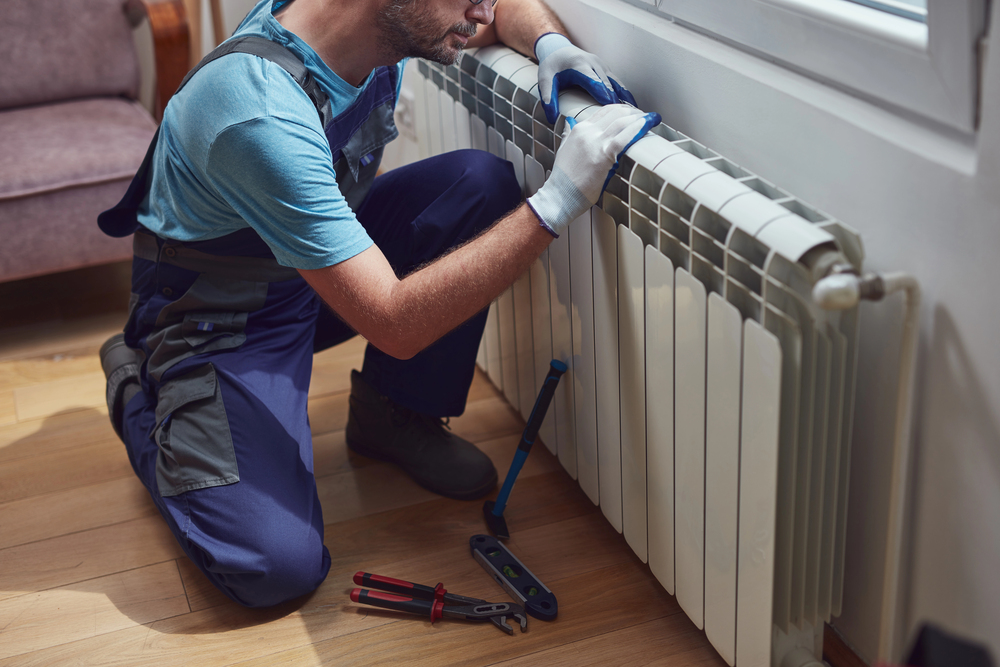
The first test is simple: run the heating for an hour and feel every radiator across its full surface, from top to bottom and side to side.
Look out for:
- a radiator that stays cold at the top but warms at the bottom
- a radiator that stays cold at the bottom while the top is warm
- radiators that remain cold altogether
- ticking or gurgling sounds in the pipework
- radiator valves and thermostatic heads that are stuck
- furniture, curtains or covers blocking heat output
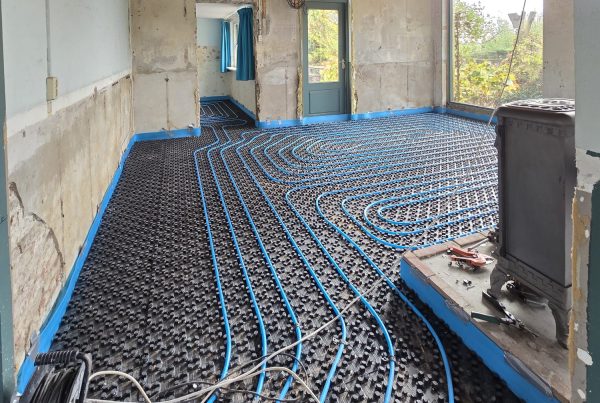
A cold top usually indicates air in the system. A cold bottom points instead to sludge or deposits, which requires a different approach than bleeding. With underfloor heating, the check takes place at the manifold. Confirm that every circuit is flowing, that the flow meters roughly match the set values and that each loop genuinely warms up. If one circuit lags behind, balancing or flushing is needed. A poorly balanced system heats one room too quickly and another far too slowly.
Bleeding the system and restoring pressure
Bleeding follows a fixed order: start with the radiator closest to the boiler on the lowest floor, then work upwards and outwards. Switch off the circulation pump or the heating first, so that air can rise towards the bleed points.
After bleeding, the water pressure drops. Check the pressure gauge and top up to the value specified by the manufacturer or installer, usually somewhere between 1.5 and 2 bar on a cold system.
More important than the pressure itself is how it behaves over time. If the pressure falls again within a few weeks without any bleeding, something else is happening: a leak, a failing expansion vessel, or a relief valve passing water. That is not a maintenance point but a repair point.
Testing the thermostat, controls and heat pump
In practice, the control system determines more about comfort and consumption than the output of the boiler or heat pump.
Before autumn, check:
- whether the time programme still matches the household’s routine
- whether the batteries in a wireless thermostat are still good
- whether the connection between thermostat and boiler is stable
- whether the flow temperature suits the heat emitters in the house
- whether weather-compensated controls are correctly configured
A heat pump adds specific points. The outdoor unit must be clear of leaves and vegetation, with enough space around it for airflow. Filters in an indoor unit or ventilation system should be clean. It is also sensible to confirm before winter that the defrost cycle runs normally and that condensate drains away properly, so that ice does not form during the first frost.
Ventilation: the step most often skipped
As soon as windows stay closed, the moisture load inside the home increases. Showering, cooking, washing and drying produce a considerable amount of water vapour every day, and it has to go somewhere.
Before the heating season, check:
- the filters in a mechanical ventilation or heat-recovery unit
- extraction capacity in the bathroom, kitchen and toilet
- whether ventilation grilles in the frames are open and clean
- whether extraction ducts are free of obstruction
- whether the ventilation unit operates on the correct setting
A simple test: hold a sheet of paper against the extraction valve. If it does not stay in place by itself, extraction is too weak. That is a signal the system needs attention before winter begins.
Checking frames, windows and doors for air leakage
Heat does not only escape through building elements, but also through joints and connections. These losses are relatively straightforward to limit.
Work through the following:
- the seals and draught profiles around opening sections
- the adjustment of hinges and locking hardware
- the junction between frame and façade
- the letterbox, cat flap and meter cupboard door
- the loft or attic hatch
- the crawl space hatch and service penetrations
If a noticeable draught remains after adjustment, the problem often lies not in the hardware but in how the frame connects to the structure. That warrants a more thorough assessment.
Assessing roof, wall and floor insulation
Where the first steps concern installations, insulation determines how much heat the system has to deliver in the first place. A check before autumn is a good moment to establish whether something structural is at play.
| Element | What you can check yourself | When a specialist is needed |
| Radiators | cold zones, noise | persistent flow problems |
| System pressure | gauge reading | repeated pressure loss |
| Thermostat | programme and switching | control system faults |
| Ventilation | filters, airflow | insufficient capacity |
| Air sealing | draughts at joints | poor frame connections |
| Insulation | cold surfaces, condensation | thermal imaging and moisture testing |
A wall that feels clearly colder than the rest of the room, condensation in one specific spot or mould forming in a corner are signals that rarely resolve themselves. In those cases, thermal imaging or moisture readings give a more reliable picture than an assessment by feel.
“Many people think that bleeding the system and topping up the pressure together count as maintenance. They do not – that is treating a symptom. Maintenance means establishing why air keeps entering the system and why the pressure keeps falling. Every autumn we see installations that have been topped up three years running while a leak was there the whole time.” — Robert Siutkowski, CEO Renoverend
When should the check become an energy-efficiency renovation?
Sometimes an autumn inspection produces more than a list of small repairs. When several findings point to the same underlying cause, it makes more sense to look at the property as a whole than to keep resolving individual components.
That applies, for example, when:
- several rooms structurally fail to reach temperature
- heating costs rise without any change in use
- there are both damp complaints and draught complaints
- a heat pump is being considered in the longer term
- the property still has single or outdated glazing
- a kitchen, bathroom or loft renovation is already planned
In those situations, the order of work matters. Insulation and airtightness come before replacing the heat source, and installations are specified once the property’s heat loss is known. Reversing that order often means paying for capacity that turns out to be unnecessary once insulation is in place.
Where measures may qualify for national or local support, it is also worth documenting the technical specifications, quotations and invoices fully from the outset.
The heating season does not begin on the day the heating comes on, but on the day you check whether it still does its job properly.
FAQ
1. When should I have my heating system checked?
Ideally in August or September, well before the system is used intensively every day.
2. How often does a boiler need servicing?
This depends on the appliance and how it is used. Many manufacturers and installers work with an interval of one to two years.
3. Why does my radiator stay cold at the bottom?
A cold bottom often indicates sludge or restricted flow. Bleeding usually does not help in that case.
4. What pressure should my heating system have?
Usually between 1.5 and 2 bar on a cold system, unless the manufacturer or installer specifies otherwise.
5. Does a heat pump need preparation before winter?
Yes. Clean filters, a clear outdoor unit, proper condensate drainage and a checked flow temperature setting all matter.
6. Should ventilation stay on during winter?
Yes. In a well-sealed home, continuous ventilation is exactly what prevents moisture problems and poor indoor air quality.