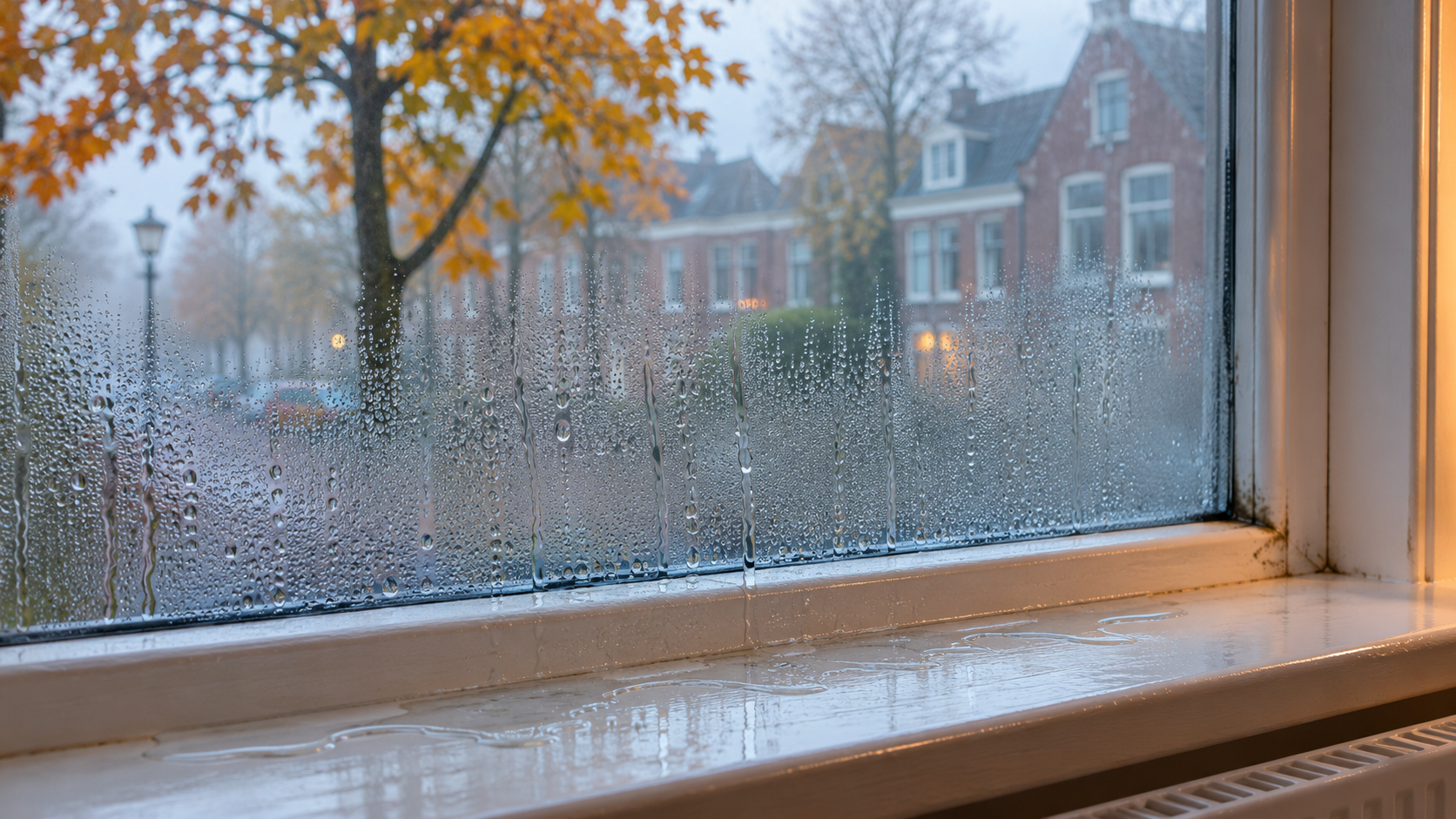
Almost every household contains one person who opens the window the moment anyone walks into the kitchen, and one person who closes that same window within thirty seconds while pointing out that we are not here to heat the street. Both are convinced they are right. What is striking is that both actually are – they are simply measuring different things. One is watching the air, the other is watching the bill.
Why indoor humidity rises in autumn
An average household produces a considerable amount of water vapour every day. Showering, cooking, washing up, laundry, drying clothes, houseplants and even breathing all contribute. In summer this goes largely unnoticed, because windows and doors are open anyway and the moisture leaves by itself.
As soon as it gets colder outside, two things change at once. The windows close, so the moisture stays in. And the outside air cools, which means the surfaces inside the home – windows, external walls, corners – become colder too. Warm air can hold more moisture than cold air, so as soon as that humid indoor air meets a cold surface, it releases part of that moisture.
That is the entire mechanism. The home has not suddenly become damper; less is being removed, and there are more cold spots where moisture can collect.
The difference between ventilating and cooling the house down
This is where the misunderstanding that sustains the argument begins. Ventilating and cooling down are often treated as the same thing, while technically they are almost opposites.
Ventilating means continuously replacing humid indoor air with drier outdoor air at a modest rate. Grilles, a trickle vent or a mechanical system do this permanently, and the heat stored in floors, walls and furniture largely remains.
Airing means opening a window wide for a short period. Within a few minutes the air is replaced, while the structure barely cools. Once the window closes, the room returns to temperature quickly.
Cooling down is what happens when a window sits ajar for half an hour with the radiator running beneath it. The structure itself becomes cold, and then has to be reheated.
The practical rule is therefore not “window open” or “window closed”, but: short and wide rather than long and ajar.
Who is right in the window argument?
| Approach | Effect on moisture | Effect on heat |
| Window permanently ajar | moderate | constant loss |
| Short, wide airing | good | limited |
| All windows kept closed | poor | favourable, until moisture appears |
| Ventilation grilles open | good and continuous | limited |
| Mechanical ventilation | good and controllable | limited, less with heat recovery |
Whoever wants continuous ventilation is right about the moisture. Whoever wants to retain the heat is right about the loss. The solution is not for one of them to win, but a change in how the air is replaced.
Condensation on windows: harmless or a signal?
A little condensation on a cold morning is not immediately worrying, certainly not in the bathroom or kitchen straight after use. It becomes a signal when the pattern repeats.
Pay attention when:
- condensation returns daily and no longer clears
- water stands on the window sill
- the window seals discolour and turn black
- moisture appears on walls rather than only on glass
- mould forms in corners or behind furniture
- windows in one specific room mist up consistently
Interestingly, condensation on single glazing often stays confined to the glass itself. The glass is then the coldest surface in the room and acts as a collection point. Replace that glass with well-insulating units without increasing ventilation, and the same moisture looks for a new coldest spot – often an external corner or the edge of a ceiling. The problem was not created by the new glazing, but it has been visibly relocated by it.
“This argument is rarely about ventilation at all. It is about two people each protecting something: one the air, the other the bill. We only see that shift when people understand that the bill does not rise from ventilating, but from the way they do it. A window ajar for half an hour costs heat; three minutes wide open costs almost nothing.” — Robert Siutkowski, CEO Renoverend
When does moisture indicate a building problem?
Not every damp complaint can be resolved by airing more effectively. There are situations where occupant behaviour is not the cause.
Consider a structural cause when:
- the damp returns to the same spot regardless of season
- a wall or corner feels noticeably colder than the rest of the room
- a damp patch appears with no clear link to showering or cooking
- the problem started after insulation or glazing was replaced
- moisture rises from the floor or the base of a wall
- the patch grows during rain, or conversely during frost
The last two point not to condensation but to another water source, such as a leak or ground moisture. That is a different type of problem requiring a different approach: ventilating will not help, and the source has to be traced first.
A cold corner usually indicates a thermal bridge – a point in the structure where heat escapes faster than through the rest of the wall. That point becomes the coldest surface in the room and attracts the moisture, exactly as the window did before.
What mechanical ventilation does and does not do
A home with mechanical ventilation does not free its occupants from thinking about air. The system only works when it is maintained and when air can actually enter.
In practice that means:
- keeping filters clean or replacing them in time
- not closing or taping over extraction valves
- leaving grilles and supply openings open
- allowing enough gap beneath internal doors for airflow
- running ventilation longer after showering or cooking
- not leaving the system permanently on its lowest setting
That last point is the most common intervention in Dutch homes. The lowest setting is quieter and feels more economical, but when it is used continuously, the volume of extracted air falls below what the property needs.
The battle over the window is rarely about the window – it is about moisture that has to go somewhere.
FAQ
1. How often should I ventilate in winter?
Maintain continuous background ventilation, supplemented by short, wide airing after showering, cooking and laundry.
2. Is a window on the latch enough?
For air exchange it is limited, and it cools the structure over a long period. Opening wide briefly works better.
3. Why do my windows mist up since the new glazing?
Often not because of the glass. When ventilation does not increase alongside better insulation, the same moisture finds another cold surface.
4. Does ventilating use a lot of energy?
Limited, provided it is brief and targeted. Leaving a window ajar above a running radiator costs considerably more.
5. Does a dehumidifier help?
Temporarily, in managing the symptom, but it does not remove the cause of the moisture.
6. When should I call in a specialist?
With recurring damp patches in the same place, with mould, or with moisture unrelated to showering and cooking.