It sounds contradictory: a property is renovated, insulated and fitted with new glazing, and only afterwards do damp patches and mould appear that were not there before. Yet this is one of the most common complaints following a renovation, and it is rarely coincidence. Building work brings water into the property, changes the distribution of temperature within the structure and makes the home more airtight. Anyone who leaves those three effects out of the programme will encounter them once the work is done.
This article concerns moisture the property itself produces or retains. When water enters from outside – through the roof, a terrace, the façade or a pipe – that is a leak, and a different problem requiring a different approach.
BConstruction moisture: how much water is in a new finish?
A renovation introduces considerable quantities of water. Screeds, plaster, tile adhesive, levelling compound, poured floors and masonry all contain water that has to evaporate again after application. In an average project this amounts to hundreds of litres distributed through the structure.
That moisture does not leave the building by itself. It evaporates into the indoor air and then has to be extracted. Until that happens, humidity inside the property rises well above normal occupied levels.
The consequences are recognisable:
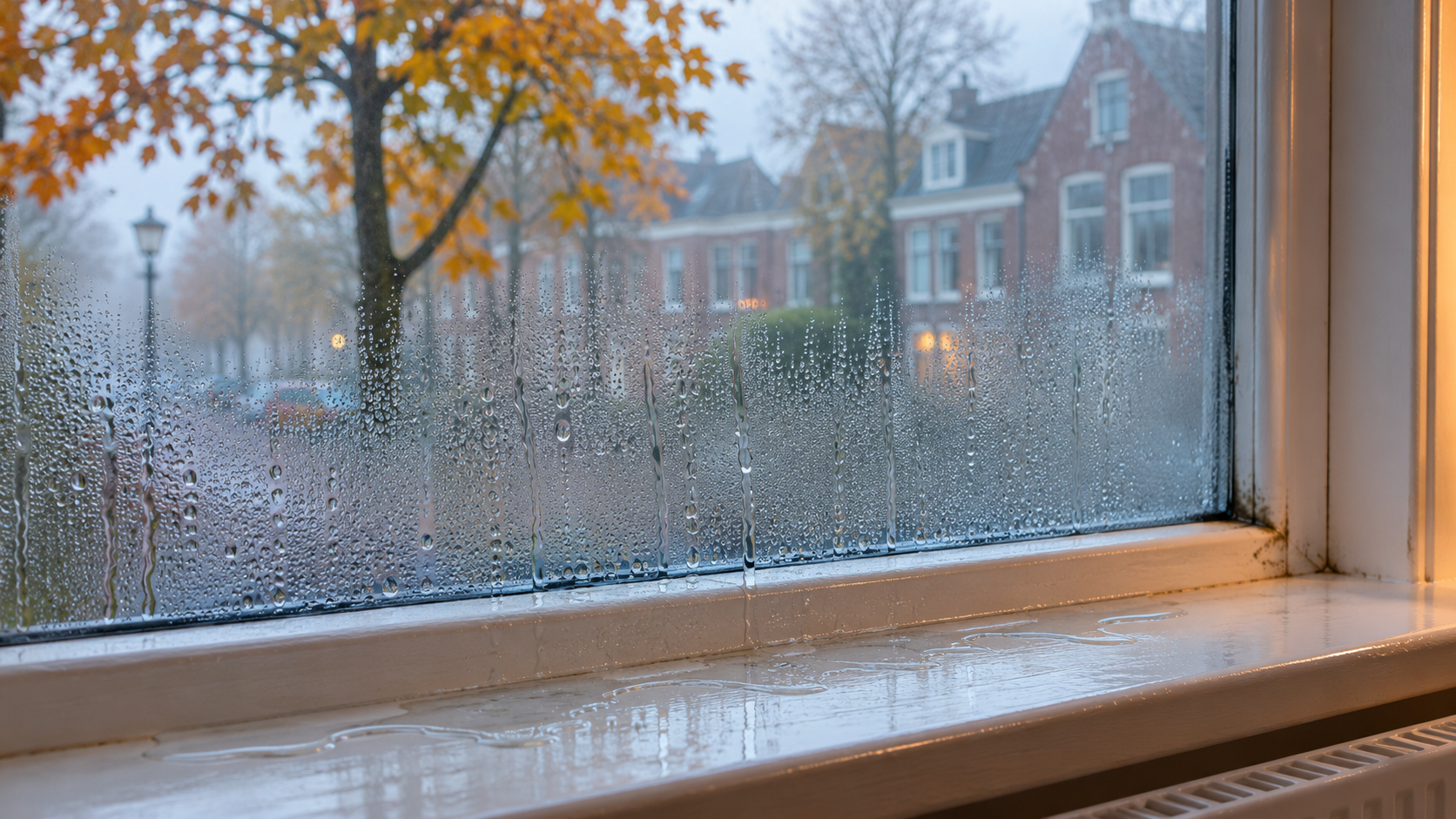
- windows misting up for days on end
- a musty smell in newly finished rooms
- moisture settling on the coldest surfaces
- mould forming within weeks of handover
- timber moving or lifting
- paint and wallpaper failing to adhere properly
Construction moisture is therefore not a defect but a normal phase. It only becomes a problem when the programme leaves no room for it.
Finishing too early: moisture that gets sealed in
The second cause follows directly from the first. When a screed or plastered wall is finished before residual moisture falls within the permitted value, that moisture is trapped beneath a layer that barely lets it through.
This happens for example with:
- a floor finish laid on a screed that has not fully cured
- tiling on a substrate that is still too damp
- vapour-tight paint on fresh plaster
- vinyl or PVC on a floor that was never measured
- skirtings and trim fitted against damp walls
- a poured floor over a substrate with excessive residual moisture
The moisture does not disappear; it finds the weakest point. Often that is the edge of the floor, a junction with a wall, or a spot where the finish is more vapour-open. The stain appears there, usually weeks or months after handover, and usually well away from where the cause lies.
Thermal bridges: where moisture settles first
A thermal bridge is a point in the structure where heat escapes faster than through the surrounding elements. The surface there is cooler, and because moisture always condenses on the coldest plane, that is exactly where condensation and later mould develop.
During a renovation, thermal bridges appear or shift in predictable places:
- the junction between an insulated wall and an uninsulated floor
- the eaves and ridge after new roof insulation
- the perimeter of a newly fitted window frame
- continuous concrete floor edges and balconies
- a cavity wall that has been only partly insulated
- the transition to an adjoining unheated space
Partial insulation carries the greatest risk. When one part of the envelope performs better and another does not, the difference in surface temperature actually increases. The insulation work itself is not badly executed; the junctions were simply not included.
Airtight insulation without a ventilation plan
The third cause is the most structural. Insulation and air sealing reduce the uncontrolled loss of air through gaps, joints and old window frames. That is precisely the intention, because those gaps cost energy. But the same gaps also removed moisture, without anyone noticing.
After insulation work the balance therefore changes:
- the property loses less heat
- the property also removes less moisture
- indoor air becomes more humid at the same level of use
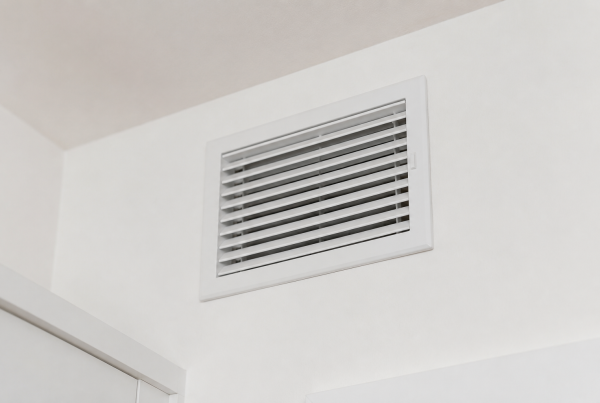
- old ventilation openings have often been removed or blocked
- no new, controlled extraction has replaced them
Insulation and ventilation therefore belong in the same plan. Making a home more airtight without designing the ventilation alongside it simply moves the problem from the energy bill to the indoor climate.
When does each cause become visible?
| Cause | Characteristic | When it appears |
| Construction moisture | condensation everywhere, musty smell | first weeks after handover |
| Trapped moisture | staining at edges and junctions | after weeks to months |
| Thermal bridge | always the same cold spot | first cold period |
| Insufficient ventilation | damp in bathroom, bedrooms, corners | first heating season |
| Leak | patch grows with rain or use | independent of season |
The last row is included only so it can be ruled out. When a patch grows during rain, after someone showers in the room above, or with no relationship to temperature at all, ventilating and drying is not the answer. The source has to be traced first.
Why moisture measurements are not a formality
A screed that feels dry can still be well above the permitted value internally. The surface dries first, while the core stays wet longest. A measurement is therefore the only reliable way to establish whether finishing can begin.
What matters:
- measuring in the core of the floor, not at the surface
- measuring in several locations, including the thickest zones
- allowing for thickness, binder type and drying conditions
- recording the measurement with date and location
- matching the permitted value to the chosen finish
- taking the measurement before ordering the final finish
Flooring suppliers generally tie their guarantee to this value. A missing measurement is therefore not only a technical risk but a liability risk.
“A house is not a collection of separate components but a single system that moves air, heat and moisture. Change one part and the rest changes with it. That is why damp complaints so often appear after a renovation: good work was done on one element, while the balance of the whole was never reassessed.” — Robert Siutkowski, CEO Renoverend
Drying during and after the renovation
The drying phase is not waiting time but a construction phase, and it can be actively managed.
What helps:
- heating and ventilating together rather than separately
- using dehumidifiers combined with removal of the humid air
- opening windows briefly and wide rather than leaving them ajar
- keeping the temperature constant rather than letting it fluctuate
- not closing off rooms to save heat
- observing drying times per material rather than by feel
A common mistake is running a dehumidifier in a fully closed room with no air exchange. The unit removes moisture from the air, but the moisture from the structure keeps circulating in the same space. Drying only works when the extracted air is genuinely removed or the condensate is discharged.
Why painting over mould does not work
Mould is not a stain but an organism that grows where moisture, temperature and a food source meet. Paint removes none of those three factors. An anti-mould paint can at best delay regrowth on a surface that has already been cleaned and whose cause has been removed.
The order is therefore always:
- identify the cause: condensation, trapped moisture or an external source
- remove or control that cause
- clean or remove the affected materials
- allow the substrate to dry fully and measure that dryness
- only then refinish
Reverse this order, and the mould returns in exactly the same place, usually within one heating season.
How do you prevent it at the planning stage?
Most damp problems after a renovation are scheduling problems. They arise when drying times are shortened, or when insulation and ventilation are considered separately by different parties.
Include in the plan in advance:
- drying times for screed, plaster and levelling as working days
- measurement points for residual moisture with a defined threshold
- a ventilation concept matched to the new insulation level
- detailing of junctions in insulation and window work
- a heating and ventilation regime during the finishing phase
- coordination between contractor, installer and flooring supplier
With these points on paper, they do not have to be improvised on site at the moment the programme comes under pressure.
Damp after a renovation is almost never a lack of craftsmanship – it is a lack of time in the programme.
FAQ
1. How long does construction moisture take to disappear?
It depends on material, thickness and drying conditions. For a screed this is usually counted in weeks rather than days.
2. Why do I have mould since the new insulation?
Usually because the property became more airtight without the ventilation being adjusted, or because a junction now forms a thermal bridge.
3. Can I simply clean mould away?
Cleaning removes the visible growth, but without addressing the cause the mould returns.
4. How do I know whether my screed is dry enough?
Only through a measurement in the core of the floor. A dry-feeling surface says little about the residual moisture beneath.
5. Does a dehumidifier help?
Yes, provided the humid air is also removed and heating is applied at the same time. In a fully sealed room its effect is limited.
6. Is damp after a renovation the contractor’s responsibility?
That depends on the cause and on what was agreed. Recorded drying times and moisture measurements make that question considerably easier to answer afterwards.